Well, it seems I am a little behind the times on SNL. Apparently this sketch was released kind of awhile ago, but I just came across it today. Anyway, it's called "Djesus Uncrossed" and is a parody of the Oscar-nominated Quentin Tarantino movie "Django Unchained." Actually, Django actor Christoph Waltz actually participated in Djesus as the title character. Needless to say, the sketch has created quite a bit of controversy and debate because of its subject matter. It involves a resurrected "Djesus" (the "D" is silent) taking revenge, which is often quite violent and bloody, (no surprises for a Quentin Tarantino parody), on the Roman soldiers who were responsible for his crucifixion. Here's a link to youtube where the clip can be found:
http://youtu.be/m2pK60VlnJ8
Anyway, the clip has caused quite a bit of controversy since it has been released, drawing fire mainly from religious people for obvious reasons. Here's an article from Religion News that deals with this:
http://www.religionnews.com/2013/02/20/did-snl-cross-a-line-in-djesus-unchained-skit/
Interesting! Stuff like this is always up for interpretation...
Sunday, April 21, 2013

Crypto-Jews
A few weeks ago, we were researching Jewish history in the US for my other religion class and I came across this New York Times article that dealt with the "hidden legacy" of Jews in the US. Basically, it was about people in New Mexico who were descendants of Spanish “conversos,” people who were practicing Catholicism yet still clung secretly to their Jewish roots. These Spanish Jews fled Spain after it issued the Edict of Expulsion in 1492 and many of them ended up in the American Southwest after much effort to avoid the reach of the Inquisition. Now, these people’s descendents are only now rediscovering their Jewish heritage, which is leading many of them in different directions- some are embracing their Jewish heritage whilst others desire to remain Catholic. Overall, I thought this article was very interesting and I had never before heard anything about these so-called “secret” Jews. It’s also interesting to me that these people continued to remain almost in hiding even when they were out of Spain’s reach in the U.S. Jewish history even in the U.S. is a lot more secretive and hidden than I had previously known. Here's the link to the article if anyone wants to read it. It's actually kind of fascinating!
http://www.nytimes.com/1990/11/11/us/scholars-and-descendants-uncover-hidden-legacy-of-jews-in-southwest.html
http://www.nytimes.com/1990/11/11/us/scholars-and-descendants-uncover-hidden-legacy-of-jews-in-southwest.html
Thursday, April 18, 2013
Consubstantiation vs Transubstantiation
I think this was brought up in class the other day, but I thought I might as well write a blog post that clarifies the difference between the concept of consubstantiation and the concept of transubstantiation. Both deal with the interpretation of Holy Communion, which was actually a source of conflict in the Protestant Reformation. The difficulty arose because the Catholic Church held, and still holds, with the idea of transubstantiation- which essentially means that they believe the bread and wine of communion literally transforms into the body and blood of Christ while Martin Luther and his Protestant followers believed more in the concept of consubstatiation. In contrast to transubstantiation, where the bread and wine are literally changed, consubstantiation holds with the idea that the bread and wine are more symbolic representations of the body and blood of Christ. While this seems to be an almost trivial and unimportant distinction, it defines a line in doctrine between two separate sects of Christianity. However, since both the Catholics and Protestants obviously still both consider Communion holy, this argument seems a bit like a technicality to me. But then, I'm not a theologian in any way, shape, or form.
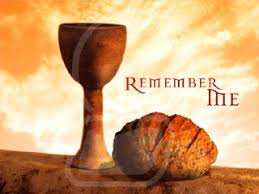

Interesting interpretation of the idea that the bread and wine literally transform themselves into the actual body and blood of Jesus.
Interesting interpretation of the idea that the bread and wine literally transform themselves into the actual body and blood of Jesus.
Christianity in Harry Potter
Once upon a time, I was really bored over spring break and decided to, yet again, read the final book of the Harry Potter series, The Deathly Hallows. As I did so, I found a couple lines in the book that seemed to reference Bible verses, which I didn't remember noticing before. The two lines in question actually were inscriptions on Harry's parents' graves and Dumbledore's family's graves respectively: "The last enemy that shall be destroyed is death" and "where your treasure is, there will your heart be also." So, the first verse is 1 Corinthians 15:26 and the second one is Matthew 6:21. However, while it seems to many that there are lots of Christian themes in the Harry Potter novels- such as sacrifice, forgiveness, life after death, love, etc- many people have also condemned JK Rowling's novels for having pagan and occult themes as well- such as witchcraft, magic, astrology, numerology, etc. Actually, here are a couple of articles that deal with both.
http://www.telegraph.co.uk/culture/books/fictionreviews/3668658/J-K-Rowling-Christianity-inspired-Harry-Potter.html
http://www.cbn.com/spirituallife/onlinediscipleship/harrypottercontroversy/elliott_richardabanes.aspx
In the first one, JK Rowling reveals that Christianity was one of her main inspirations and that the Harry Potter books reflect her own struggle with faith, and the other one claims that Harry Potter is detrimental to kids and could be a "doorway to the occult." I personally love Harry Potter and never for an instant even thought about calling it bad for children, but as these two articles demonstrate, there are many different ways to interpret the same thing. Although, I think the article with JK Rowling is pretty definitive and that Harry Potter was not intended to be the so-called "doorway to the occult." Now, one could probably talk about and analyze the potential Christian themes in Harry Potter for ages as there are thousands of pages contained within the series, but here is a website that is devoted to exploring them.
http://potter-sacrifice.webs.com/preliminaryoutline.htm
However, it clearly focuses on the themes of love and sacrifice that can be found within the Harry Potter series. Obviously, the most prominent example of this would be the way that Lily sacrificed herself for Harry.

Interesting...
http://www.telegraph.co.uk/culture/books/fictionreviews/3668658/J-K-Rowling-Christianity-inspired-Harry-Potter.html
http://www.cbn.com/spirituallife/onlinediscipleship/harrypottercontroversy/elliott_richardabanes.aspx
In the first one, JK Rowling reveals that Christianity was one of her main inspirations and that the Harry Potter books reflect her own struggle with faith, and the other one claims that Harry Potter is detrimental to kids and could be a "doorway to the occult." I personally love Harry Potter and never for an instant even thought about calling it bad for children, but as these two articles demonstrate, there are many different ways to interpret the same thing. Although, I think the article with JK Rowling is pretty definitive and that Harry Potter was not intended to be the so-called "doorway to the occult." Now, one could probably talk about and analyze the potential Christian themes in Harry Potter for ages as there are thousands of pages contained within the series, but here is a website that is devoted to exploring them.
http://potter-sacrifice.webs.com/preliminaryoutline.htm
However, it clearly focuses on the themes of love and sacrifice that can be found within the Harry Potter series. Obviously, the most prominent example of this would be the way that Lily sacrificed herself for Harry.
Interesting...
Wednesday, April 17, 2013
Les Miserables
As I'm sure most of you know, the musical Les Miserables became a world wide phenomenon again this year with the new Oscar-nominated remake. Like any good musical and Hugh Jackman fan, I decided to see it and now thought I could maybe blog about Christian themes that are found throughout the movie, mainly in the main Hugh-Jackman embodied character of Jean Valjean. In the musical, which is based off of a Victor Hugo novel, Valjean is an ex-prisoner out on parole when he finds God and decides to turn over a new leaf. In fact, this Christian post article talks about Christian values found in the movie; these include "forgiveness, hope, grace, and redemption." As the movie progresses, it often seems as though Valjean's whole life is just a bundle of Christian ideals- actually, a line from "Amazing Grace" seems to fit him perfectly: "I once was lost, but now I'm found." In addition to containing Christian themes, Les Mis also explicitly references God and the Bible several times. For example, in one of the songs, Valjean claims he is on a "never-ending road to Calvary." Calvary is, of course, the place where Jesus went to be crucified- this line then seems to draw a parallel between Valjean and Jesus himself. Another well-known line from the movie is "to love another person is to see the face of God." This quote seems to point to the Bible verse "God is love" and implies that God is responsible for all of the love that we feel on this planet. This could actually be a really long post, but I think I'll stop there. But if anyone's interested, here's the link to the Christian post article I read:
http://www.christianpost.com/news/les-miserables-the-perfect-christian-movie-87850/
There's also many more articles out there that discuss this, but I would say the best way to see if Christian themes really are in the movie would be to watch it and decide for yourself!
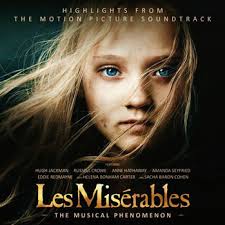
http://www.christianpost.com/news/les-miserables-the-perfect-christian-movie-87850/
There's also many more articles out there that discuss this, but I would say the best way to see if Christian themes really are in the movie would be to watch it and decide for yourself!
Sunday, April 14, 2013
Religion in the Constitution
Since many people think the US is a nation founded upon religion and its values, I thought it would be interesting to do a bit of research and actually see how much religion explicitly shows up in some of our country's founding documents. Actually, what I found was a bit surprising. Interestingly enough, there are no direct mentions of religion or support of a religion in the Constitution. The only time it comes close to talking about religion is when it bans religious tests in Article 6. Religion is also regulated in the Bill of Rights with the Establishment Clause (which forbids the government from establishing an official religion) and the Free Exercise Clause (which protects freedom of religion). It seems as though the founders, when writing the Constitution, did not want to throw support to any one religion and were adamant about having a separation between church and state, which makes sense because they were attempting to create a nation that would have religious freedom. So, far from backing up any religion, the writers of the Constitution only brought up religion in order to regulate it. However, this is not the case in the Declaration of Independence. That document, mentions God several times, most famously in the "endowed by their Creator with certain unalienable rights" line. There, though, God was used as an argument and a justification to declare independence while the Constitution was meant to outline and set up the government. The two documents were meant for different purposes and therefore utilize God differently. Or, in the case of the Constitution, not at all.
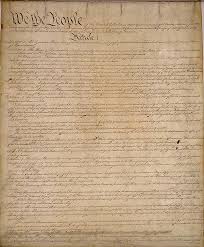
The Constitution!

The Declaration of Independence!
The Constitution!
The Declaration of Independence!
Tuesday, April 9, 2013
The Holy Grail
Might as well continue the Monty Python theme that I've been using. This time, I'm choosing to write about a mythical object that is at the center of the Monty Python movie in question and can be found in many popular movies and books such as Indiana Jones and The DaVinci Code. In case those hints aren't enough, the object I'm referring to is the Holy Grail. Traditionally, the Holy Grail is believed to be the cup Jesus drank out of during the Last Supper. However, there is also a hypothesis that the term "Holy Grail" refers to the bloodline and descendants of Jesus himself. This is the idea put forth in The DaVinci Code and in the book, had something to do in the difference between "San Greal" and "Sang Real." Apparently while one meant "Holy Grail," the other meant "Royal Blood."
In Indiana Jones and the Last Crusade, Indiana Jones races against the Nazis to find the Holy Grail, which is believed to be the Cup of Christ. Interestingly enough, there's apparently some truth in this story. The article on the website below deals with archaeology under Hitler. Evidently, Heinrich Himmler, the chief of the SS, went to Spain at one point to investigate a possible location of the Grail. And, the article says that "The chief architect and manager of the Nazi Holocaust believed that finding the grail 'would help Germany win the war and give him supernatural powers.'" Fascinating. It seems as though the Nazis actually were interested in obtaining Biblical artifacts.
http://www.dailymail.co.uk/news/article-2298716/The-REAL-Last-Crusade-Nazi-search-Holy-Grail-inspired-Indiana-Jones.html
I have had problems embedding clips lately, but if you search Indiana Jones and the Last Crusade clips on youtube, one involving the scene where they find the Holy Grail should appear.

This is the Holy Grail as depicted in the Monty Python movie.
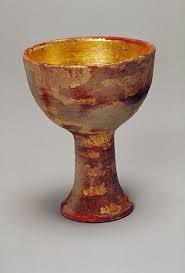
This is the Grail seen in Indiana Jones and the Last Crusade.

Much of the Holy Grail legend is tied to the Last Supper. This painting, as I'm sure most of you know, is called The Last Supper and was painted by Leonardo DaVinci. Needless to say, it comes up in The DaVinci Code.
In Indiana Jones and the Last Crusade, Indiana Jones races against the Nazis to find the Holy Grail, which is believed to be the Cup of Christ. Interestingly enough, there's apparently some truth in this story. The article on the website below deals with archaeology under Hitler. Evidently, Heinrich Himmler, the chief of the SS, went to Spain at one point to investigate a possible location of the Grail. And, the article says that "The chief architect and manager of the Nazi Holocaust believed that finding the grail 'would help Germany win the war and give him supernatural powers.'" Fascinating. It seems as though the Nazis actually were interested in obtaining Biblical artifacts.
http://www.dailymail.co.uk/news/article-2298716/The-REAL-Last-Crusade-Nazi-search-Holy-Grail-inspired-Indiana-Jones.html
I have had problems embedding clips lately, but if you search Indiana Jones and the Last Crusade clips on youtube, one involving the scene where they find the Holy Grail should appear.
This is the Holy Grail as depicted in the Monty Python movie.
This is the Grail seen in Indiana Jones and the Last Crusade.
Much of the Holy Grail legend is tied to the Last Supper. This painting, as I'm sure most of you know, is called The Last Supper and was painted by Leonardo DaVinci. Needless to say, it comes up in The DaVinci Code.
Subscribe to:
Posts (Atom)