
Friday, May 3, 2013
The Book of Mormon...the Musical!!
Since I was just posting information on the LDS Church not 30 seconds ago, I thought it might be enjoyable to talk about the Book of Mormon, the musical! While not quite the same as the actual Book of Mormon, obviously, this musical has been a huge success. Here's a synopsis from a Broadway website: "The Book of Mormon follows two young missionaries who are sent to Uganda to try to convert citizens to the Mormon religion. One missionary, Elder Price, is an enthusiastic go-getter with a strong dedication to his faith, while his partner, Elder Cunningham, is a socially awkward but well meaning nerd whose tendency to embroider the truth soon lands him in trouble. Upon their arrival in Africa, Elders Price and Cunningham learn that in a society plagued by AIDS, poverty and violence, a successful mission may not be as easy as they expected." Funnily enough, it was written by South Park creators Trey Parker and Matt Stone as well as Avenue Q's Robert Lopez. This information should provide any viewer with an inkling as to what type of humor is present in the musical- it has been called an "equal opportunity offender." No surprises there for something out of the heads of the guys who made South Park. The Mormon Church issued this response as a reaction to the musical: "The production may attempt to entertain audiences for an evening, but the Book of Mormon as a volume of scripture will change people's lives forever by bringing them closer to Christ." Unsurprisingly, it seems that they might not find the musical that amusing.

The Mormon Church
I was looking up Mormonism for the final and figured I might as well do a blog post on them while I was at it. I knew quite a few people from my hometown that were Mormons but I never quite understood what exactly they believed. So, I thought it would be interesting to do a bit of background info on them! The LDS Church (Church of Jesus Christ of Latter-Day Saints) was officially established in 1830 by Joseph Smith in upstate New York. There, Smith, who apparently was only a farm boy, became to be seen as a prophet when he received visions from God and discovered what would become the Book of Mormon on some gold plates buried in a hill. http://eom.byu.edu/index.php/History_of_the_Church
After leaving New York, the Mormons, under Brigham Young, eventually settled in Utah and, today, Salt Lake City is the center of their church. Mormonism is a faith centered almost exclusively in the U.S. and today they have over fourteen million members. The basics beliefs of the LDS Church were laid out by Joseph Smith himself in “The Thirteen Articles of Faith” and include a belief that both the Bible and the Book of Mormon were divinely inspired. They also absolutely believe in revelation and visionsand follow strict rules concerning chastity, modesty,virtue, etc. They do not hold with the doctrine of original sin, and they believe that the New Jerusalem will be built upon the American continent.
http://www.religionfacts.com/mormonism/beliefs/13_articles.htm

After leaving New York, the Mormons, under Brigham Young, eventually settled in Utah and, today, Salt Lake City is the center of their church. Mormonism is a faith centered almost exclusively in the U.S. and today they have over fourteen million members. The basics beliefs of the LDS Church were laid out by Joseph Smith himself in “The Thirteen Articles of Faith” and include a belief that both the Bible and the Book of Mormon were divinely inspired. They also absolutely believe in revelation and visionsand follow strict rules concerning chastity, modesty,virtue, etc. They do not hold with the doctrine of original sin, and they believe that the New Jerusalem will be built upon the American continent.
http://www.religionfacts.com/mormonism/beliefs/13_articles.htm
Wednesday, May 1, 2013
Divine Science
 I randomly came across a religion called Divine Science the other day and I didn't know much about it. So, here we are. I thought I might as well post some background info about it! It was founded in 1887 by Nona Lovell Brooks, Fannie Brooks James, and Aletha Brooks. While practicing the belief of the Omniprescent of God, they came into contact with a woman named Malinda Cramer in San Francisco who was practicing a similar principle. Both woman began practicing this principle after having experienced almost miraculous healings. The two similar schools of thought came together and Divine Science was born. Thus, Divine Science in the U.S. started in two places: San Francisco and Denver. It is basically a spiritual religion that believes in the “oneness” and omniprescence of God with the goal of releasing material desires and becoming one with this God. It is practiced by “turning attention from the outer visible effects of this world to the inner world of the First Cause” and some examples and teachings of Jesus Christ are followed as well. Divine Science is still around today, and is estimated to have around 5,000 members.
http://www.divinescience.org/index.html
The Shakers...and love!
I believe they were briefly brought up in class a few days ago, so I thought I might post something about this article. But first, let's do a bit of background information on the Shakers themselves. The Shakers were a new religious movement founded in the 19th century by Mother Ann Lee and are more formally known as the United Society of Believers in Christ's Second Appearing. In a nutshell, their core principles are: restorationism, celibacy, communitarianism, pacifism, simplicity, and God as a father-mother. Although at their height there were nearly 5,000 members, today there are apparently only three Shakers left, all of whom reside in Sabbathday Lake, Maine. Due to the celibacy rule, it's hard for them to get new members. However, there used to be four Shakers until very recently. This article below describes the love story between a Boston Globe journalist, Stacey Chase, and the youngest of the remaining Shakers, Brother Wayne. Apparently, Chase was sent to the Sabbathday Lake community to write a story on the Shakers when she met Wayne Smith. This started what sounds like a romance straight out of some random movie. You know, the whole star-crossed lovers, secret phone calls, "forbidden love" type thing. Anyway, what eventually happened was that Wayne renounced his vow of celibacy after 26 years and married Stacey at a Methodist Church in Vermont.
http://www.boston.com/bostonglobe/magazine/articles/2010/02/28/he_left_the_shakers_for_love/

http://www.boston.com/bostonglobe/magazine/articles/2010/02/28/he_left_the_shakers_for_love/
Catholic Church Excommunicates Brazilian Priest
Yet again, my daily excursion through Yahoo news has provided me with a blog post. This article deals with a Brazilian priest that has been excommunicated by the Catholic Church for possessing views seen as too liberal. Father Roberto Francisco Daniel, aka "Padre Beto," was accused of heresy and schism after "betraying the promise of fealty to the church." Evidently, Father Roberto had defended homosexuality and open marriage in several online videos. Seen by some as a "rebel son" who habitually "crosses the line," Daniel did not seem to be that upset about his excommunication. On the contrary, he stated that "I feel honored to belong to the long list of people who have been murdered and burned alive for thinking and searching for knowledge."
http://news.yahoo.com/catholic-church-excommunicates-brazil-priest-liberal-views-212205334.html
http://news.yahoo.com/catholic-church-excommunicates-brazil-priest-liberal-views-212205334.html
Monday, April 22, 2013
China Comments on Religion
While conducting my usual routine of scrolling through the Yahoo News articles, I came across one that dealt with China and religion, called "China says aims to banish superstition, promote knowledge." Apparently, China experienced more than just an economic boom in recent years. It also has experienced an explosion of religion, having an estimated 100 million believers- half of which are Christian and Muslim while the other half are Buddhist/Daoist. Head of the State Administration of Religious Affairs, Wang Zuoan, hypothesizes that this has occurred because people are desiring reassurance in an "increasingly complex world." Although the Chinese government, ruled by the Communist Party, is officially atheist, they have conceded the fact that sometimes religion is capable of producing social harmony. However, that still isn't stopping them from trying to get their citizens to establish what they see as a "correct world view," and to deal with problems scientifically instead of superstitiously. That being said, they have accepted the fact that this will be a long process because, as Zuoan puts it, "Religion has been around for a very long time, and if we rush to try to push for
results and want to immediately 'liberate' people from the influence of religion, then it will
have the opposite effect and push people in the opposite direction."
http://news.yahoo.com/china-says-aims-banish-superstition-promote-knowledge-055415307.html
http://news.yahoo.com/china-says-aims-banish-superstition-promote-knowledge-055415307.html
Sunday, April 21, 2013
Messiah
One of the most famous and beloved pieces of music ever written is Handel's Messiah. It is normally played at Christmastime (although it premiered on Easter), and is most recognizable through the Hallelujah Chorus. While George Frederic Handel was considered a successful German composer and one of the most notable composers of the Baroque time period, the writing of Messiah still seems to be kind of an unlikely story. Born in Germany in 1685, Handel first moved to Italy in attempt to compose opera. This was largely a failure, however, so Handel moved back to Germany and then eventually to England, where he would write and perform for King George himself. However, this relationship was often up and down, and Handel eventually fell out of favor. In 1737, he apparently had a debilitating stroke that both caused blurry vision and paralyzed his right arm, making it impossible for him to play or conduct. On top of this, he was not the best businessman; this left him rather deep in debt. It was in this situation and state of mind that Handel came across a liberetto by Charles Jennens, which was divided into three parts and dealt with all aspects of the story of Jesus Christ, the Messiah. This story would provide the inspiration that would lead to Handel's unlikely composition of a Christian oratorio- this oratorio would become one of the most celebrated Christian musical pieces of all time: Messiah. In fact, while writing the most well known part of this composition, the Hallelujah Chorus, Handel claimed that "I did think I saw heaven open, and saw the very face of God."
http://blog.beliefnet.com/bibleandculture/2009/12/handels-messiah----the-story-behind-the-classic.html
Here's a link to see the Mormon Tabernacle Choir singing the Hallelujah Chorus:
http://youtu.be/S4BWhvIlFVE

http://blog.beliefnet.com/bibleandculture/2009/12/handels-messiah----the-story-behind-the-classic.html
Here's a link to see the Mormon Tabernacle Choir singing the Hallelujah Chorus:
http://youtu.be/S4BWhvIlFVE
Djesus Uncrossed
Well, it seems I am a little behind the times on SNL. Apparently this sketch was released kind of awhile ago, but I just came across it today. Anyway, it's called "Djesus Uncrossed" and is a parody of the Oscar-nominated Quentin Tarantino movie "Django Unchained." Actually, Django actor Christoph Waltz actually participated in Djesus as the title character. Needless to say, the sketch has created quite a bit of controversy and debate because of its subject matter. It involves a resurrected "Djesus" (the "D" is silent) taking revenge, which is often quite violent and bloody, (no surprises for a Quentin Tarantino parody), on the Roman soldiers who were responsible for his crucifixion. Here's a link to youtube where the clip can be found:
http://youtu.be/m2pK60VlnJ8
Anyway, the clip has caused quite a bit of controversy since it has been released, drawing fire mainly from religious people for obvious reasons. Here's an article from Religion News that deals with this:
http://www.religionnews.com/2013/02/20/did-snl-cross-a-line-in-djesus-unchained-skit/
Interesting! Stuff like this is always up for interpretation...
http://youtu.be/m2pK60VlnJ8
Anyway, the clip has caused quite a bit of controversy since it has been released, drawing fire mainly from religious people for obvious reasons. Here's an article from Religion News that deals with this:
http://www.religionnews.com/2013/02/20/did-snl-cross-a-line-in-djesus-unchained-skit/
Interesting! Stuff like this is always up for interpretation...
Crypto-Jews
A few weeks ago, we were researching Jewish history in the US for my other religion class and I came across this New York Times article that dealt with the "hidden legacy" of Jews in the US. Basically, it was about people in New Mexico who were descendants of Spanish “conversos,” people who were practicing Catholicism yet still clung secretly to their Jewish roots. These Spanish Jews fled Spain after it issued the Edict of Expulsion in 1492 and many of them ended up in the American Southwest after much effort to avoid the reach of the Inquisition. Now, these people’s descendents are only now rediscovering their Jewish heritage, which is leading many of them in different directions- some are embracing their Jewish heritage whilst others desire to remain Catholic. Overall, I thought this article was very interesting and I had never before heard anything about these so-called “secret” Jews. It’s also interesting to me that these people continued to remain almost in hiding even when they were out of Spain’s reach in the U.S. Jewish history even in the U.S. is a lot more secretive and hidden than I had previously known. Here's the link to the article if anyone wants to read it. It's actually kind of fascinating!
http://www.nytimes.com/1990/11/11/us/scholars-and-descendants-uncover-hidden-legacy-of-jews-in-southwest.html
http://www.nytimes.com/1990/11/11/us/scholars-and-descendants-uncover-hidden-legacy-of-jews-in-southwest.html
Thursday, April 18, 2013
Consubstantiation vs Transubstantiation
I think this was brought up in class the other day, but I thought I might as well write a blog post that clarifies the difference between the concept of consubstantiation and the concept of transubstantiation. Both deal with the interpretation of Holy Communion, which was actually a source of conflict in the Protestant Reformation. The difficulty arose because the Catholic Church held, and still holds, with the idea of transubstantiation- which essentially means that they believe the bread and wine of communion literally transforms into the body and blood of Christ while Martin Luther and his Protestant followers believed more in the concept of consubstatiation. In contrast to transubstantiation, where the bread and wine are literally changed, consubstantiation holds with the idea that the bread and wine are more symbolic representations of the body and blood of Christ. While this seems to be an almost trivial and unimportant distinction, it defines a line in doctrine between two separate sects of Christianity. However, since both the Catholics and Protestants obviously still both consider Communion holy, this argument seems a bit like a technicality to me. But then, I'm not a theologian in any way, shape, or form.
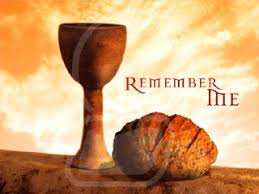

Interesting interpretation of the idea that the bread and wine literally transform themselves into the actual body and blood of Jesus.
Interesting interpretation of the idea that the bread and wine literally transform themselves into the actual body and blood of Jesus.
Christianity in Harry Potter
Once upon a time, I was really bored over spring break and decided to, yet again, read the final book of the Harry Potter series, The Deathly Hallows. As I did so, I found a couple lines in the book that seemed to reference Bible verses, which I didn't remember noticing before. The two lines in question actually were inscriptions on Harry's parents' graves and Dumbledore's family's graves respectively: "The last enemy that shall be destroyed is death" and "where your treasure is, there will your heart be also." So, the first verse is 1 Corinthians 15:26 and the second one is Matthew 6:21. However, while it seems to many that there are lots of Christian themes in the Harry Potter novels- such as sacrifice, forgiveness, life after death, love, etc- many people have also condemned JK Rowling's novels for having pagan and occult themes as well- such as witchcraft, magic, astrology, numerology, etc. Actually, here are a couple of articles that deal with both.
http://www.telegraph.co.uk/culture/books/fictionreviews/3668658/J-K-Rowling-Christianity-inspired-Harry-Potter.html
http://www.cbn.com/spirituallife/onlinediscipleship/harrypottercontroversy/elliott_richardabanes.aspx
In the first one, JK Rowling reveals that Christianity was one of her main inspirations and that the Harry Potter books reflect her own struggle with faith, and the other one claims that Harry Potter is detrimental to kids and could be a "doorway to the occult." I personally love Harry Potter and never for an instant even thought about calling it bad for children, but as these two articles demonstrate, there are many different ways to interpret the same thing. Although, I think the article with JK Rowling is pretty definitive and that Harry Potter was not intended to be the so-called "doorway to the occult." Now, one could probably talk about and analyze the potential Christian themes in Harry Potter for ages as there are thousands of pages contained within the series, but here is a website that is devoted to exploring them.
http://potter-sacrifice.webs.com/preliminaryoutline.htm
However, it clearly focuses on the themes of love and sacrifice that can be found within the Harry Potter series. Obviously, the most prominent example of this would be the way that Lily sacrificed herself for Harry.

Interesting...
http://www.telegraph.co.uk/culture/books/fictionreviews/3668658/J-K-Rowling-Christianity-inspired-Harry-Potter.html
http://www.cbn.com/spirituallife/onlinediscipleship/harrypottercontroversy/elliott_richardabanes.aspx
In the first one, JK Rowling reveals that Christianity was one of her main inspirations and that the Harry Potter books reflect her own struggle with faith, and the other one claims that Harry Potter is detrimental to kids and could be a "doorway to the occult." I personally love Harry Potter and never for an instant even thought about calling it bad for children, but as these two articles demonstrate, there are many different ways to interpret the same thing. Although, I think the article with JK Rowling is pretty definitive and that Harry Potter was not intended to be the so-called "doorway to the occult." Now, one could probably talk about and analyze the potential Christian themes in Harry Potter for ages as there are thousands of pages contained within the series, but here is a website that is devoted to exploring them.
http://potter-sacrifice.webs.com/preliminaryoutline.htm
However, it clearly focuses on the themes of love and sacrifice that can be found within the Harry Potter series. Obviously, the most prominent example of this would be the way that Lily sacrificed herself for Harry.
Interesting...
Wednesday, April 17, 2013
Les Miserables
As I'm sure most of you know, the musical Les Miserables became a world wide phenomenon again this year with the new Oscar-nominated remake. Like any good musical and Hugh Jackman fan, I decided to see it and now thought I could maybe blog about Christian themes that are found throughout the movie, mainly in the main Hugh-Jackman embodied character of Jean Valjean. In the musical, which is based off of a Victor Hugo novel, Valjean is an ex-prisoner out on parole when he finds God and decides to turn over a new leaf. In fact, this Christian post article talks about Christian values found in the movie; these include "forgiveness, hope, grace, and redemption." As the movie progresses, it often seems as though Valjean's whole life is just a bundle of Christian ideals- actually, a line from "Amazing Grace" seems to fit him perfectly: "I once was lost, but now I'm found." In addition to containing Christian themes, Les Mis also explicitly references God and the Bible several times. For example, in one of the songs, Valjean claims he is on a "never-ending road to Calvary." Calvary is, of course, the place where Jesus went to be crucified- this line then seems to draw a parallel between Valjean and Jesus himself. Another well-known line from the movie is "to love another person is to see the face of God." This quote seems to point to the Bible verse "God is love" and implies that God is responsible for all of the love that we feel on this planet. This could actually be a really long post, but I think I'll stop there. But if anyone's interested, here's the link to the Christian post article I read:
http://www.christianpost.com/news/les-miserables-the-perfect-christian-movie-87850/
There's also many more articles out there that discuss this, but I would say the best way to see if Christian themes really are in the movie would be to watch it and decide for yourself!
http://www.christianpost.com/news/les-miserables-the-perfect-christian-movie-87850/
There's also many more articles out there that discuss this, but I would say the best way to see if Christian themes really are in the movie would be to watch it and decide for yourself!
Sunday, April 14, 2013
Religion in the Constitution
Since many people think the US is a nation founded upon religion and its values, I thought it would be interesting to do a bit of research and actually see how much religion explicitly shows up in some of our country's founding documents. Actually, what I found was a bit surprising. Interestingly enough, there are no direct mentions of religion or support of a religion in the Constitution. The only time it comes close to talking about religion is when it bans religious tests in Article 6. Religion is also regulated in the Bill of Rights with the Establishment Clause (which forbids the government from establishing an official religion) and the Free Exercise Clause (which protects freedom of religion). It seems as though the founders, when writing the Constitution, did not want to throw support to any one religion and were adamant about having a separation between church and state, which makes sense because they were attempting to create a nation that would have religious freedom. So, far from backing up any religion, the writers of the Constitution only brought up religion in order to regulate it. However, this is not the case in the Declaration of Independence. That document, mentions God several times, most famously in the "endowed by their Creator with certain unalienable rights" line. There, though, God was used as an argument and a justification to declare independence while the Constitution was meant to outline and set up the government. The two documents were meant for different purposes and therefore utilize God differently. Or, in the case of the Constitution, not at all.
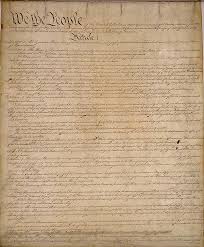
The Constitution!

The Declaration of Independence!
The Constitution!
The Declaration of Independence!
Tuesday, April 9, 2013
The Holy Grail
Might as well continue the Monty Python theme that I've been using. This time, I'm choosing to write about a mythical object that is at the center of the Monty Python movie in question and can be found in many popular movies and books such as Indiana Jones and The DaVinci Code. In case those hints aren't enough, the object I'm referring to is the Holy Grail. Traditionally, the Holy Grail is believed to be the cup Jesus drank out of during the Last Supper. However, there is also a hypothesis that the term "Holy Grail" refers to the bloodline and descendants of Jesus himself. This is the idea put forth in The DaVinci Code and in the book, had something to do in the difference between "San Greal" and "Sang Real." Apparently while one meant "Holy Grail," the other meant "Royal Blood."
In Indiana Jones and the Last Crusade, Indiana Jones races against the Nazis to find the Holy Grail, which is believed to be the Cup of Christ. Interestingly enough, there's apparently some truth in this story. The article on the website below deals with archaeology under Hitler. Evidently, Heinrich Himmler, the chief of the SS, went to Spain at one point to investigate a possible location of the Grail. And, the article says that "The chief architect and manager of the Nazi Holocaust believed that finding the grail 'would help Germany win the war and give him supernatural powers.'" Fascinating. It seems as though the Nazis actually were interested in obtaining Biblical artifacts.
http://www.dailymail.co.uk/news/article-2298716/The-REAL-Last-Crusade-Nazi-search-Holy-Grail-inspired-Indiana-Jones.html
I have had problems embedding clips lately, but if you search Indiana Jones and the Last Crusade clips on youtube, one involving the scene where they find the Holy Grail should appear.

This is the Holy Grail as depicted in the Monty Python movie.
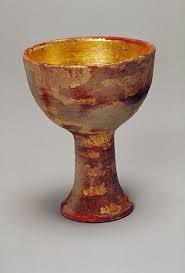
This is the Grail seen in Indiana Jones and the Last Crusade.

Much of the Holy Grail legend is tied to the Last Supper. This painting, as I'm sure most of you know, is called The Last Supper and was painted by Leonardo DaVinci. Needless to say, it comes up in The DaVinci Code.
In Indiana Jones and the Last Crusade, Indiana Jones races against the Nazis to find the Holy Grail, which is believed to be the Cup of Christ. Interestingly enough, there's apparently some truth in this story. The article on the website below deals with archaeology under Hitler. Evidently, Heinrich Himmler, the chief of the SS, went to Spain at one point to investigate a possible location of the Grail. And, the article says that "The chief architect and manager of the Nazi Holocaust believed that finding the grail 'would help Germany win the war and give him supernatural powers.'" Fascinating. It seems as though the Nazis actually were interested in obtaining Biblical artifacts.
http://www.dailymail.co.uk/news/article-2298716/The-REAL-Last-Crusade-Nazi-search-Holy-Grail-inspired-Indiana-Jones.html
I have had problems embedding clips lately, but if you search Indiana Jones and the Last Crusade clips on youtube, one involving the scene where they find the Holy Grail should appear.
This is the Holy Grail as depicted in the Monty Python movie.
This is the Grail seen in Indiana Jones and the Last Crusade.
Much of the Holy Grail legend is tied to the Last Supper. This painting, as I'm sure most of you know, is called The Last Supper and was painted by Leonardo DaVinci. Needless to say, it comes up in The DaVinci Code.
Mega-Church Pastor Victim of an Internet Hoax
So, while I was just randomly flipping through Yahoo News stories, I came across this one. Apparently, Joel Osteen, a televangelist and leader of the 45,000 member Lakewood Church in Houston, was victim of an Internet hoax that falsely quoted him as saying he was leaving the Christian faith. It seems that a fake website that was pretending to be Osteen's official site made a fake announcement that Osteen was rejecting Christ after having concluded that "the Bible is a fallible, flawed, highly inconsistent history book that has been altered hundreds of times. There is zero evidence that the Bible is the holy word of God. In fact, there is zero evidence that 'God' even exists." Evidently though, Osteem was not angry and "true to form, is turning the other cheek and spinning this bit of adversity as part of his core message."
http://gma.yahoo.com/blogs/abc-blogs/joel-osteen-turns-other-cheek-internet-hoax-143435452--abc-news-topstories.html
http://gma.yahoo.com/blogs/abc-blogs/joel-osteen-turns-other-cheek-internet-hoax-143435452--abc-news-topstories.html
Monday, April 8, 2013
Witch Trials
Throughout history, there have been accusations of witchcraft and occurrences of witch trials around the world. Of course, the most famous here in the U.S. are the Salem Witch Trials that occurred in Massachusetts in the late seventeenth century. I think most everyone who has ever taken an American History class is pretty familiar with what happened, so I thought I would just do a brief description. Basically, around the 1690s, the Puritans in Salem had a strong belief that Satan was acting in their world. They had recently experienced difficult times and already believed in an "invisible world", which apparently made this seem more plausible. Evidently, they thought that Satan recruited people, mainly women, to work for him and these women were the so-called "witches" responsible for any misfortune that occurred in the town. Eventually, the situation snowballed and turned into a mass hysteria type occurrence. By the end of it, nineteen people had died after being publicly executed, mainly by hanging. Now I know this isn't really a funny subject, but I think I should lighten the mood a bit by sharing a clip from Monty Python and the Holy Grail. I referenced earlier when I blogged about Gregorian Chants, but it works just as well for witchcraft. Enjoy!
http://youtu.be/zrzMhU_4m-g
I can't get the video to embed correctly, but this link should take you to the video!
http://youtu.be/zrzMhU_4m-g
I can't get the video to embed correctly, but this link should take you to the video!
Thursday, April 4, 2013
The Ark of the Covenant
Once upon a time, on one boring evening over spring break, I rewatched the original Indiana Jones movie, Raiders of the Lost Ark. For those who don't know, Indiana Jones is an archaeologist who races against both time and Nazis to recover the lost Ark of the Covenant in the ancient Egyptian city of Tanis. In the movie, the Ark demonstrates many supernatural and deadly powers, these are most likely based upon a legend that the Ark was associated with several Old Testament miracles, including the fall of the Jericho walls. As far as Biblical relics are concerned, the Ark is one of the most searched for. In the Old Testament, the Ark was the ornate case built by the Israelites to house the stone tablets of the Ten Commandments. The Israelites carried the Ark around with them throughout their journeys, including the famed Exodus from Egypt. It is described as a chest made of gold-plated wood and topped with two golden angels. However, between 597 and 586 B.C., the Babylonians conquered the Israelites and the Ark, which was supposedly stored in the Temple of Jerusalem, was lost.
http://science.nationalgeographic.com/science/archaeology/ark-covenant/
I was going to share a video from youtube that showed the opening of the Ark in the Indiana Jones movie, but my computer doesn't seem to want to do that at the moment. Anyway, you can find the video on youtube if you search Raiders of the Lost Ark. The Ark replication used in the movie seems to follow the description given in the Bible pretty well. However, the lightning bolts that shoot out of it might be just some dramatization but I suppose you never know.
http://science.nationalgeographic.com/science/archaeology/ark-covenant/
I was going to share a video from youtube that showed the opening of the Ark in the Indiana Jones movie, but my computer doesn't seem to want to do that at the moment. Anyway, you can find the video on youtube if you search Raiders of the Lost Ark. The Ark replication used in the movie seems to follow the description given in the Bible pretty well. However, the lightning bolts that shoot out of it might be just some dramatization but I suppose you never know.
Wednesday, April 3, 2013
Flowering the Cross
I apologize, but I forgot to blog about this Easter custom and I think it's kind of interesting. My church at home does this, and I participated in it last Sunday. In fact, I helped to cut the flowers beforehand. Anyway, it is traditional in some churches to decorate a cross with cut flowers on Easter Sunday. Although the cross was originally a cruel form of execution, this website says that "the cross stands at the center of our faith as a symbol of life." Therefore, it is fitting that the cross be decorated with flowers to represent life on the day that represents Jesus's returning to life and conquering of death. In addition, the image of a flowering cross has been found in Christian art as early as the sixth century, and it apparently is "based on a legend that says that the cross itself burst into bloom at the moment that Jesus died." An account of this custom as well as many others can be found on this website: http://fullhomelydivinity.org/articles/easter%20customs.htm


Religiosity in the U.S.
Interestingly enough, throughout the U.S. there are varying amounts of religiosity. For instance, the South as a whole claims higher rates of adherence than say, the West or the New England area. In the west, and in Colorado in particular, there is a growing group of people unaffiliated with any religion (so-called "nones"). Actually, a correlation can kind of be seen between these religious differences and political divides found throughout the country. But I digress. Anyway, what I'm really getting at here is that a new Gallup poll came out recently that found the most, and least religious cities in the country. Not surprisingly, the most religious places were in Utah, which has a large population of LDS affiliates, and the South. And guess what city came in a close second for least religious city in the U.S.?????? I'll give you a hint...We live there.
Yes, Boulder, CO came in pretty much tied with Burlington, VT for the least religious city, with only 17.3% of the population classified as "very religious." This is opposed to the 77% found in the top city of Provo, UT. I can't say this really came as a shock, but I still found it interesting!
Here's the link to a Denver Post article talking about it as well as a link to another Gallup poll measuring overall country wide religiosity:
http://www.denverpost.com/ci_22907780?source=bb
http://www.theblaze.com/stories/2013/02/14/gallup-these-are-the-10-most-and-least-religious-states-in-america/
Yes, Boulder, CO came in pretty much tied with Burlington, VT for the least religious city, with only 17.3% of the population classified as "very religious." This is opposed to the 77% found in the top city of Provo, UT. I can't say this really came as a shock, but I still found it interesting!
Here's the link to a Denver Post article talking about it as well as a link to another Gallup poll measuring overall country wide religiosity:
http://www.denverpost.com/ci_22907780?source=bb
http://www.theblaze.com/stories/2013/02/14/gallup-these-are-the-10-most-and-least-religious-states-in-america/
More Easter Traditions
I know this post is also a little belated, but seems to have been the trend of late. This is the last one about Easter, I promise! I thought I would just wrap up Easter completely with a small discussion about the Easter Bunny and some coverage of the annual White House Easter Egg Roll. As would possibly be expected, the Easter Bunny tradition does not exactly have anything to do with the Christian holiday of Easter, but is instead associated with pre-Christian fertility lore- apparently rabbits were the most fertile animals known at the time and therefore were associated with new life during the Spring season. This obviously could be related to the history of the name "Easter" itself, which comes from a pagan goddess of fertility. As an Easter symbol, the bunny originated in Germany in the 1500s and was introduced to American folklore by German immigrants to the Pennsylvania Dutch area of the U.S. in the 1700s. All of this information comes from this website: http://www.easterbunnys.net/easterbunnyhistory.htm
Another American Easter tradition is the annual White House Easter Egg Roll. It is one of the oldest annual White House events, as it has been occurring on Easter Monday since 1878. Some historians hypothesize that this tradition was first suggested by Dolley Madison, but records of actual informal egg-rolling parties can be dated back to President Lincoln. This year, Barack and Michelle Obama hosted the 135th Easter Egg Roll on the South Lawn with more than 30,000 guests in attendance. In accordance with some of the First Lady's goal to fight obesity, the theme was "Be Healthy, Be Active, Be You." In addition to simply attending, the guests were also presented with commemorative wooden eggs that bore the signatures of every member of the First Family, including their dog.
http://www.whitehouse.gov/blog/2013/04/01/be-healthy-be-active-be-you-2013-white-house-easter-egg-roll
http://www.whitehousehistory.org/whha_shows/holidays_easter/index.html

Another American Easter tradition is the annual White House Easter Egg Roll. It is one of the oldest annual White House events, as it has been occurring on Easter Monday since 1878. Some historians hypothesize that this tradition was first suggested by Dolley Madison, but records of actual informal egg-rolling parties can be dated back to President Lincoln. This year, Barack and Michelle Obama hosted the 135th Easter Egg Roll on the South Lawn with more than 30,000 guests in attendance. In accordance with some of the First Lady's goal to fight obesity, the theme was "Be Healthy, Be Active, Be You." In addition to simply attending, the guests were also presented with commemorative wooden eggs that bore the signatures of every member of the First Family, including their dog.
http://www.whitehouse.gov/blog/2013/04/01/be-healthy-be-active-be-you-2013-white-house-easter-egg-roll
http://www.whitehousehistory.org/whha_shows/holidays_easter/index.html

Subscribe to:
Posts (Atom)