
Wednesday, April 3, 2013
Flowering the Cross
I apologize, but I forgot to blog about this Easter custom and I think it's kind of interesting. My church at home does this, and I participated in it last Sunday. In fact, I helped to cut the flowers beforehand. Anyway, it is traditional in some churches to decorate a cross with cut flowers on Easter Sunday. Although the cross was originally a cruel form of execution, this website says that "the cross stands at the center of our faith as a symbol of life." Therefore, it is fitting that the cross be decorated with flowers to represent life on the day that represents Jesus's returning to life and conquering of death. In addition, the image of a flowering cross has been found in Christian art as early as the sixth century, and it apparently is "based on a legend that says that the cross itself burst into bloom at the moment that Jesus died." An account of this custom as well as many others can be found on this website: http://fullhomelydivinity.org/articles/easter%20customs.htm


Religiosity in the U.S.
Interestingly enough, throughout the U.S. there are varying amounts of religiosity. For instance, the South as a whole claims higher rates of adherence than say, the West or the New England area. In the west, and in Colorado in particular, there is a growing group of people unaffiliated with any religion (so-called "nones"). Actually, a correlation can kind of be seen between these religious differences and political divides found throughout the country. But I digress. Anyway, what I'm really getting at here is that a new Gallup poll came out recently that found the most, and least religious cities in the country. Not surprisingly, the most religious places were in Utah, which has a large population of LDS affiliates, and the South. And guess what city came in a close second for least religious city in the U.S.?????? I'll give you a hint...We live there.
Yes, Boulder, CO came in pretty much tied with Burlington, VT for the least religious city, with only 17.3% of the population classified as "very religious." This is opposed to the 77% found in the top city of Provo, UT. I can't say this really came as a shock, but I still found it interesting!
Here's the link to a Denver Post article talking about it as well as a link to another Gallup poll measuring overall country wide religiosity:
http://www.denverpost.com/ci_22907780?source=bb
http://www.theblaze.com/stories/2013/02/14/gallup-these-are-the-10-most-and-least-religious-states-in-america/
More Easter Traditions
I know this post is also a little belated, but seems to have been the trend of late. This is the last one about Easter, I promise! I thought I would just wrap up Easter completely with a small discussion about the Easter Bunny and some coverage of the annual White House Easter Egg Roll. As would possibly be expected, the Easter Bunny tradition does not exactly have anything to do with the Christian holiday of Easter, but is instead associated with pre-Christian fertility lore- apparently rabbits were the most fertile animals known at the time and therefore were associated with new life during the Spring season. This obviously could be related to the history of the name "Easter" itself, which comes from a pagan goddess of fertility. As an Easter symbol, the bunny originated in Germany in the 1500s and was introduced to American folklore by German immigrants to the Pennsylvania Dutch area of the U.S. in the 1700s. All of this information comes from this website: http://www.easterbunnys.net/easterbunnyhistory.htm
Another American Easter tradition is the annual White House Easter Egg Roll. It is one of the oldest annual White House events, as it has been occurring on Easter Monday since 1878. Some historians hypothesize that this tradition was first suggested by Dolley Madison, but records of actual informal egg-rolling parties can be dated back to President Lincoln. This year, Barack and Michelle Obama hosted the 135th Easter Egg Roll on the South Lawn with more than 30,000 guests in attendance. In accordance with some of the First Lady's goal to fight obesity, the theme was "Be Healthy, Be Active, Be You." In addition to simply attending, the guests were also presented with commemorative wooden eggs that bore the signatures of every member of the First Family, including their dog.
http://www.whitehouse.gov/blog/2013/04/01/be-healthy-be-active-be-you-2013-white-house-easter-egg-roll
http://www.whitehousehistory.org/whha_shows/holidays_easter/index.html

Monday, April 1, 2013
Easter Eggs
A couple of days ago, my family, like families across the world, got together to decorate Easter eggs. This tradition is integral to the celebration of Easter as a holiday, so I thought it would be interesting to do a bit of research on the history of these eggs. Interestingly enough, I found that the painting of hard boiled eggs actually pre dates Christianity- for example, people have been decorating eggs on Nowruz (the Iranian New Year that occurs on the spring equinox) for thousands of years. According to a Huffington Post article, "the egg is a symbol of fertility, new life, and rebirth in cultures around the world." However, it holds meaning for Christians as well. For them, the Easter egg is symbolic of the Resurrection of Jesus Christ, with the shell evidently representing the tomb and the cracking of the shell representing the Resurrection. Apparently, in Eastern Catholic and Orthodox churches, eggs are dyed red to symbolize the blood Christ shed on the cross. In addition to the decoration of eggs, Easter egg hunts and rolls are also beloved traditions. According to the same Huffington Post article, "Eggs are rolled as a symbolic re-enactment of the rolling away of the stone from Christ’s tomb." One notable occurrence of an Easter Egg Roll occurs annually on the White House lawn.
http://www.huffingtonpost.com/2012/04/02/easter-eggs-history-origin-symbolism-tradition_n_1392054.html
Here are some particularly pretty Easter Eggs!
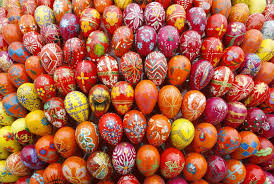
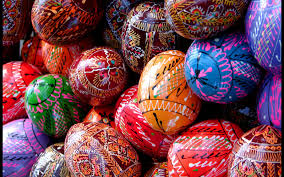
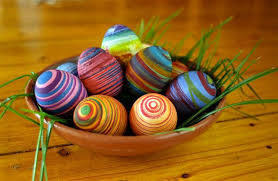
http://www.huffingtonpost.com/2012/04/02/easter-eggs-history-origin-symbolism-tradition_n_1392054.html
Here are some particularly pretty Easter Eggs!
Easter
Let the belated Holy Week posts continue! After Maundy Thursday and Good Friday, the final church service held during the Triduum (which refers to the three days in the church calendar when the Last Supper, the crucifixion, and the Resurrection are commemorated) is Easter. Celebrated on the Sunday after Good Friday, Easter marks the day Jesus was resurrection from the dead after being crucified three days before. It is a celebration held around the world and marks a stark contrast to the solemness of Good Friday- while that one grieves over the death of Jesus, this one celebrates his coming to life again, an event that is absolutely central and vital to Christian religions. Because the Resurrection represents the hope Christians have in their faith, it is celebrated with much gladness and singing. In fact, the word "Alleluia," which cannot be said during Lent, is spoken a record number of times on Easter.
Now, although Easter is a Christian holiday, it seems as though the name itself might actually have pagan origins. Interestingly enough, the website below claims that Easter might originally have gotten its name from that of a pagan goddess. Evidently, the "Teutonic dawn goddess of fertility [was] known variously as Ostare, Ostara, Ostern, Eostra, Eostre, Eostur, Eastra, Eastur, Austron and Ausos." And, it seems as though her name might be derived from the ancient word for spring: eastre.
This is a pretty interesting website on the origins of the word Easter.
http://www.religioustolerance.org/easter1.htm
Good Friday
Like the previous Maundy Thursday post, I also meant to publish this one the day of, but oh well. A little late now. Anyway, also like Maundy Thursday, Good Friday is part of Holy Week and is held on the Friday before Easter. It commemorates Christ's crucifixion and is the most somber and solemn day in the Christian calendar. According to the share faith website, "it is a time to grieve over the sin of man and to meditate and rejoice upon
God's love in giving His only Son for the redemption of sin." The Church began observing this day in around the fourth century, and the Catholic Church first adopted the name "Good Friday" in about the sixth century. Also known as the Tenebrae Service (Tenebrae is Latin for shadows), this service, or at least the one I attended, was held in almost complete darkness with the pastor wearing all black. As this would demonstrate, Good Friday is the time where Christians mourn the death of Jesus before the Easter celebrations of his Resurrection.
More information on Good Friday and its history can be found at this website:
http://www.sharefaith.com/guide/Christian-Holidays/good-friday-significance.html
More information on Good Friday and its history can be found at this website:
http://www.sharefaith.com/guide/Christian-Holidays/good-friday-significance.html
Maundy Thursday
I meant to publish this on the actual day, but last Thursday, I attended a Maundy Thursday service at my church and thought it would be a good thing to blog about. Essentially, the Maundy Thursday church service occurs on the day of the Last Supper, and the one I went to served the types of food that most likely would have been served two thousand years ago at such a supper. For some kids, their First Communion was celebrated that day as well. This celebration, which takes place every year during Holy Week on the Thursday before Easter, dates back to the first century. It takes its name from the Latin "Dias Mandatum," which is "the day of the new commandment." In addition, the sharefaith website (link attached at the bottom) describes a history of Maundy Thursday as follows:
"In the 12th century, the English Church initiated a custom of distributing money to senior citizens who had performed outstanding service to the crown. Known as "Maundy Money," these specially minted coins are handed out in red and white ceremonial purses by the reigning King or Queen. Along with the giving of alms, Kings and Queens of England would also wash the feet of the poor as a way of humbling themselves. This tradition continued until the 17th century.
In Germany, Maundy Thursday was also known as Green Thursday. The name was not due to the color green, but from the close association to the German word for "grief" or "weeping". Many families would eat only green vegetables, spinach in particular, as a way of humbling themselves before God.
In contrast to Corpus Christi, the feast of Maundy Thursday is a more somber event, and many Christians take it as a time to fast and repent before partaking of the Eucharist. This cleansing of the soul before the Good Friday service prepares the believer to better appreciate the sacrifice of Christ and the rejoicing that is to come on Easter Sunday."
http://www.sharefaith.com/guide/Christian-Holidays/history_of_maundy_thursday.html
Subscribe to:
Posts (Atom)